One of my goals for the flight home from San Diego last week was to spend time reflecting on the past two weeks, and even more on the semester than stretched before that. Once the flight crew gave the okay for electronic devices, I pulled out the iPad and iPod to craft some literary genius while surrounded by the music shuffle from my little pink companion. The first song that popped up was Belief by Gavin DeGraw, an artist I purchased during my One Tree Hill obsession (I loved being able to predict the story lines two or three episodes in advance). The lyrics declare that “Belief makes things real, makes things feel, feel alright. Belief makes things true, things like you, you and I.” Although the song is about a struggling relationship, there was still a hopefulness implied in these lyrics. He sings about a woman who has caused him pain, and for whom he has caused pain; and yet, “You stood by me.” Belief is one of my top five strengths, according to StrengthFinder; I find that my core values change very slowly, but when they do, lifestyle changes must follow.
If there is one central concept I’ve learned about in the past six months, it’s silence. I’ve learned the value of silence when trying to find the right words to begin a appear, to get something to start filling that blank screen. I’ve learned the need for silence when a hard truth is confessed, when any response would detract from the moment. I’ve learned the ease of silence when standing just beside injustice. And I’ve learned the pain of silence when standing in the midst of injustice.
During my first year of school, I tried living according to a motto: “What’s the worst that could happen? What’s the best that could happen?” This autumn, the foundation shifted as my choices shifted from a place of courage to one of survival. There’s some logic to this survival focus as I navigated a full-time career and full-time student life. It’s hard and takes work to succeed in this life. Survival ain’t bad some days. But survival isn’t good enough from the perspectives of Abraham Maslow, Daniel Pink, or Meg DuMez.
Looking toward 2015, in work, in school, in running, in relationships, I’m going to try being a little more brave and stupid a little more often. “What does ‘brave and stupid’ mean?” you ask. It means defying the silence a little more often, even when it’s personally or professionally dangerous. Because my story matters. And your story matters. And if my story can help yours, if I can help your story, that matters. Below is a part of my story; a speech I wrote for a course this semester and will be working to refine this semester for another project.
“You stood by me, and I’ll stand by my belief.”
—
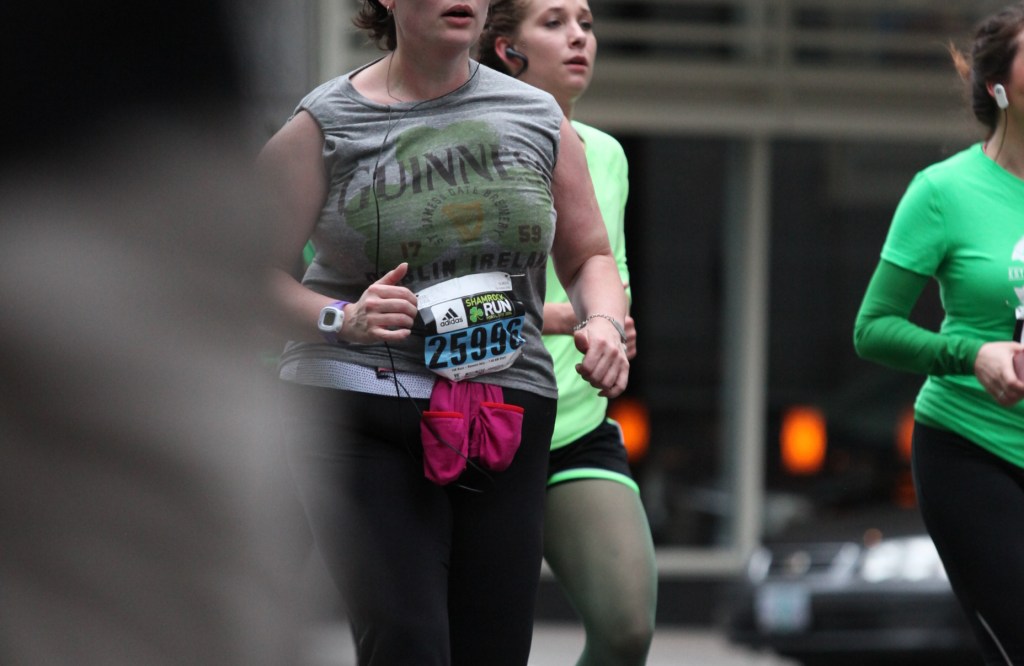
I’ve spent most of my life in my own shadow. The face I see in every photograph, the one I fear with every glance in the mirror, and the one that I stare into with almost every meal. That person is the voice in the back of my mind, defining who I am far too much, and overshadowing all of the other qualities that give me privilege or marginalization. As a fat girl, I have been called cute, smart, funny, driven, and generous. I’ve never been called beautiful, sexy, tempting, powerful, intimidating, or dangerous. One label overshadows the rest, but I am more than that one label. As Derrick Bell (Lynn & Dixson, 2013) proposed, each of us can experience times of intersectionality, when our various demographic qualities means that we can fall between the cracks of our identities. For the past six months, I’ve been trying to re-identify with my lost labels. I am fat. I am also female. I am white. I am heterosexual. I am non-disabled. I am wealthy. And I am privileged. I am these things and many more. I have strengths and resources that many women around the world do not have. But unfortunately, in my own eyes and in what feels like the eyes of the world, all I am is an out-of-control fat-assed single person, who is not truly a woman.
I started gaining weight after my mother’s remarriage; I would sneak food into my bedroom after strange hamburger helper or chicken pot pie dinners. Then it was extra Twinkies into the lunch bag and playing candy poker in the library at school. A family transition started my changes, but the open buffets at college with ice cream at every meal certainly didn’t help. There were so many good tastes and no one telling me no with words, just with looks and lack of dates. I felt good enough in the classroom, but nowhere else. I didn’t fit into the chairs at my church. I had to take a deep breath and pray that the seat belt on roller coasters would hold. And the clothing section at stores left me with floral prints, sailor tops, and plunging necklines that left me worried about flashing the world. I was constantly aware of my weight from middle school through my early years out of college, but still embraced denial and M&M’s rather than the truth. It was finally a “Come to Jesus” moment on the scale five years ago that woke me up to the 250 pounds staring up at me and all of those photos that I had buried under the bed. I was obese and no one seemed to care enough to do something about it. Not even me.
Those who struggle with weight are alone in a world of sufferers. According to a National Survey of Midlife Development in the United States, weight and height discrimination is the third most common type of discrimination for women; twice as likely as men (Puhl, Andreyeva, & Brownell, 2008). Underwood (2013) identified weight discrimination as unique among all types of prejudice because it’s socially acceptable. Overt racism, homophobia, or misogyny are unacceptable, but laughing at a fat person is just good television. Chrisler (2012) added that Americans assume that we are in full control of our bodies; therefore, fat women are out of control and not living up to the ideals. So it’s my fault that I can’t fit into those skinny jeans or display a six-pack under my tank top.
One of the amazing and difficult things about weight discrimination for women is how every woman seems to be continuously on a diet as she tries to meet society’s expectations. At the exact same time, there is no universal support system to go along with this change goal as each woman is somehow alone to succeed or fail, despite our common ground (Beren, Hayden, Wilfley, & Striegel-Moore, 1997). Farrow and Tarrant (2009) researched undergraduate students’ with maladaptive eating-related behaviors and discovered that it was the negative attitudes of their ingroups that were more influential than any general perceptions. Although God created each of us unique and wonderful, we constantly fail to see the beauty in one another or to support holistic health. Instead of support, an internal monologue takes over: “Have you lost weight? Then you must think you’re better than me. Have you gained weight? Oh, you poor thing.”
This semester I’ve had two courses that allowed me to learn more about social justice, with emphasis on the struggles of women in our nation and in developing countries. As I began focusing on weight discrimination, I learned that in general women struggle more with weight issues that men; not because of the pounds or the available carbs, but rather the social expectation that we should all be able to reach the beauty ideal (Chrisler, 2012) and the feminist expectation that women should be focused on more important issues than what size of pants I wear (a 12 thank you very much, and no, unfortunately I’m not okay with that). I found common ground between my experiences and those described by Beren, Hayden, Wilfley, and Striegel-Moore (1997) when they interviewed lesbian college students. They proposed that “Unlike most minority individuals, lesbians and gay men are initially socialized within the dominant culture, and later, within the minority subculture of the gay/lesbian community” (p. 433). The 26 women interviewed described their identity struggle about what they are supposed to care about. Thinness is often a key characteristic of what it means to be a woman (Green, Davids, Skaggs, Ripel, & Hallengren, 2008), yet feminism is focused on empowerment, human rights, and equalizing opportunities around the globe. So women are supposed to be thin and healthy to attract a mate. Smart and active to change society. And add on top of that the Christian expectation of humility, service, and worship, and it’s almost impossible to try and find a way to fit everything into 24-hours, 365-days. And this doctoral student still wants to watch Orphan Black this March.
At the same time I’m reading about Critical Race Theory and Smith’s Diversity Framework, I’m also learning about Tostan, an organization in Senegal that has a three-year program focused on human rights. I want to share just a little about them because their focus on community commitment has inspired a new hope in how colleges could create change. They are also fighting against unrealistic ideals forced on women by their loved ones. One of the primary outcomes of this organization is to end genital cutting of women. Genital cutting causes physical and emotional damage. It occurs with the parents’ approval, predominately in Muslim cultures in some African countries (Kristof & WuDunn, 2009). “Reasons for continuing the practice include the protection of women from unwanted sexual intercourse, the protection of women from their own sexuality or from an uncontrolled sexual appetite, to keep young girls virgins, to enhance fertility, to enhance femininity, to keep married women faithful, to prevent women from masturbating, and because many men will only marry a woman who has undergone this procedure” (Kinnear, 2011, p. 24). Medical evidence indicates that the practice increases scarring and probability for death by blood loss during the procedure or later during childbirth. Since Tostan began, over 7,000 communities in eight African countries have publically declared abandonment of female genital cutting and child marriage.
These issues of weight and genital cutting are just two examples of women trying to become the expectation of others. Rather than pursuing the image of God or the truer image of self proposed by Baxter Magolda (2008), women are constantly trying to become what we believe someone else wants from us. I know that I think far too much about how to be good enough, pretty enough, smart enough, fast enough, nice enough, funny enough, kind enough, and for God’s sake skinny enough for people to like me.
With all of these issues on the table, both in my own head and in our community, how could we respond using the structures of empowerment instead of limitation? Piran (2010) focused on feminist theory in developing a three-part response to weight discrimination cultures. First there is a need to look at the systemic issues related to environment and power structure. Women try to control their bodies because they cannot control the environment. Like Tostan’s work, I believe that colleges need to develop universal commitments, based on their mission statements as Smith (2009) recommended for diversity engagement, to focus on the holistic health of all students. Second, there needs to be an engagement of participants in the resolution, rather than top-down or universal assumptions. The victims of discrimination should be the primary voices in fighting back; these are survivors who need to be connected in to a community. Finally, responses cannot be limited to a one-shot intervention. Similar to diversity trainings, one teaching can leave participants worse off than they began, with guilt and new destructive behaviors instead of encouragement and community. Our media is a pervasive and constant stream of demanding images (Greenwood & Dal Cin, 2012; Pritchard & Cramblitt, 2014; Rutledge, Gillmor, & Gillen, 2013; Spurgas, 2005); a two-hour Tuesday afternoon session on inner beauty won’t change a thing.
As I consider how higher education as a system should change, I have to also consider my own role in that system and how I can place my expectations on students or embrace who they are and who they can be. As an academic advisor, I’ve worked with a variety of students that represented diversity of ethnicity, age, gender, sexuality, religion, academic preparation, socioeconomic status, and emotional stability (the police have been called on more than one occasion and security involved other times). In the past six years, I have lost four students to illness, one just a week after graduation due to pneumonia. All of that experience gave me what I thought was a strength to be able to know, after a four-hour orientation, who I was going to connect with and who was going to be trouble. After reading about intersectionality and the dangers of color-blind rhetoric (Lynn & Dixson, 2013), I am learning that my expectations limit my relationship with students and belief in the potential of each student to succeed until I am proven wrong (Bain, 2004). This semester, several sets of rose-colored glasses shattered for me as I now view media and observe my surroundings with recognition of initial assumptions about others in a new way. Perhaps six months ago I would have been comfortable in my initial judgments and return to my life without another thought. I’m not sure. But I cannot do that any longer. Instead I hope that continued work will silence those initial unconscious thoughts to allow the focus on the human being before me to come through first.
I want to honestly see the people around me, and to be more honest about who I am in return. When it comes to my identity as a child of God, due to three long-term unanswered prayers, I am a prodigal child of God. I have walked away, with full knowledge and with full demand that if he doesn’t like it, God has the power to change things. Since June, my metaphor for my relationship with God has been like that of Jacob wrestling with the angel. However God has refused to step into the ring with me and have this fight. Instead he stands outside while I pray, plead, cry, beg, cuss, demand, and occasionally flip him off just to get a reaction. In some ways, nothing has changed in six months. In other ways, the story has another chapter. During a flight to Florida for my brother’s wedding this fall, I read fictional book with two characters reading through Exodus as a meditation during a time of struggle. Somewhere over Texas, my metaphor of God expanded. The ring and the un-started wrestlers are still there, but I realized that God is standing there, in the wilderness with me. No, he isn’t responding as I so desperately wish he would, but he is present and that is something. In going back and forth with my other readings, and the events of our world in Ferguson, New York, and my own city, I’ve learned about the value of presence in the protest and defying a silence that is far too easy to embrace.
My voice, in life and in research, must be focused on something greater than the material benefits of this world. Because if it’s all about the physical, then I’m falling into the assumptions of the same world that tells me constantly that I’m not good enough. Well to Hell with that. When Jeremiah told the gathered Israelites that God had a plan for them, one with hope and a future (Jeremiah 29:11), there was an exile and generation in the desert before that promise came true. Those in the desert still had the promise of something greater. They had someone standing beside the ring with them; a God who saw them as they truly were and not as just falling short of the physical ideal. They had a promise. But silence promises nothing. So the way I want to move forward it by admitting to my story before this group, by admitting to my demons, and by refusing to remain silent in the future. My school has gone through great struggles this fall, and our country is fractured far more than any leader wants to admit. Silence doesn’t help. Denial doesn’t help. Cookies don’t help. Impossible expectations don’t help. Isolation doesn’t help. Hope. Hope helps. Words help, even when they falter, even when the voice cracks with tears. And I, an out-of-control fat-assed single woman, can help.


 Starting Line Miracles